

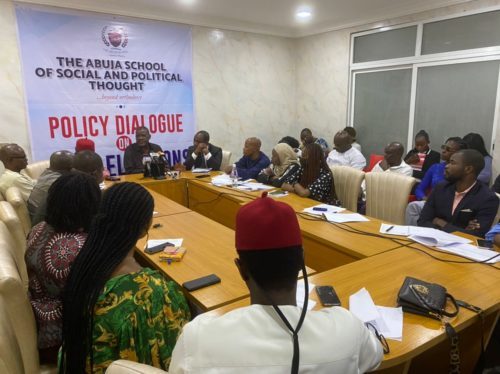
Paul Obi highlights the importance of The Abuja School of Social and Political Thought to the Nigerian discursive space
“Intellectual freedom is the only guarantee of a scientific – democratic approach to politics, economic development and culture”
– Andrei Sakharov
From time immemorial and historical accounts, societies that have evolved to great nations have achieved that through various layers of intellectual engagement, access to quality education and the enhancement of the discursive space. From the Greek Agora, the Frankfurt School, New School, Council on Foreign Relations (CFR) to new emerging Think-Tanks, the production and distribution of knowledge is at the very core of innovation and intellectual crystallization that has given birth to great nations – particularly in western societies.
Thus, knowledge production is both an engine room and a lubricant to innovation, development, growth, and even sane society. On a real, knowledge itself is not just a tangible abstract or a supersonic metaphysical concept. Until it’s channel into production, it’s merely a fluidity of no substance. Julian Landry in an edited collection, Critical Perspectives on Think-Tanks: Power, Politics and Knowledge stressed that think-tanks are increasingly becoming enduring fixtures of national and transnational sociopolitical landscape; and although they could be considerably ambivalent, they are social forces geared towards organizing knowledge production, research, ideological advocacy and political mobilization. In the 21st century world, the conceptualization of knowledge has somewhat become the central element of development, and even its existence. Therefore, anything think-tank worth its salt must produce knowledge, or perished in perpetuity.
